
Mineral vs. Chemical Sunscreen: What’s Actually in Your SPF

Sunscreen is one of those products that can get very confusing the moment you start paying attention to ingredients.
One minute you’re just trying to protect your skin. And it seems the next minute, you’re googling things like:
- mineral sunscreen vs chemical sunscreen
- oxybenzone-free
- reef-safe
- nano vs. non-nano zinc oxide
And somehow every bottle claims to be the best, safest, cleanest option. 😵💫
Here’s the good news: sunscreen labels get much easier to understand once you know what you’re actually looking for.
📌 Pin for Later

This post may contain affiliate links. As a Counter Brand Partner and Amazon Associate, I may earn a commission if you purchase through my links, at no extra cost to you. See my full disclosure for more information.
Mineral vs. Chemical Sunscreen: What’s the Difference?
Mineral sunscreens use ingredients like zinc oxide or titanium dioxide to physically protect skin from UV rays.
Chemical sunscreens work differently. They use UV filters that absorb UV radiation and can also be absorbed into the bloodstream after application. Common UV filters include:
- oxybenzone
- octinoxate
- avobenzone
- homosalate
- octisalate
- octocrylene
Both types protect against UV radiation. But they are not the same when it comes to what happens after they touch your skin. That difference is worth understanding.
Chemical Sunscreen Ingredients I Avoid
These are the sunscreen filters I personally recommend avoiding when reading labels.
Oxybenzone: Oxybenzone is the most studied and the most concerning for me. In an FDA clinical trial, it showed the highest systemic absorption of all the filters studied. And the EU restricted it after reviewing endocrine disruption evidence.
Octinoxate: Research has raised concerns about hormone disruption. It’s also been restricted by the EU. Hawaii and Key West banned both oxybenzone and octinoxate because of environmental toxicity to coral reefs.
Homosalate: Research has raised concerns about hormone disruption. The EU’s scientific committee flagged bioaccumulation, which means the body may absorb it faster than it can eliminate it.
Octisalate: Commonly used as a stabilizer in formulas. Octisalate may increase the penetration of other substances through the skin.
Octocrylene: A chemical UV filter used in sunscreens to absorb UVB rays. It can break down into benzophenone over time. Benzophenone has been associated with cancer and other health concerns.
Avobenzone: Avobenzone is one of the most common UVA filters. It is unstable in sunlight on its own, so sunscreen formulas typically include other ingredients to help stabilize it.
Why “Oxybenzone-Free” Doesn’t Always Mean Safer
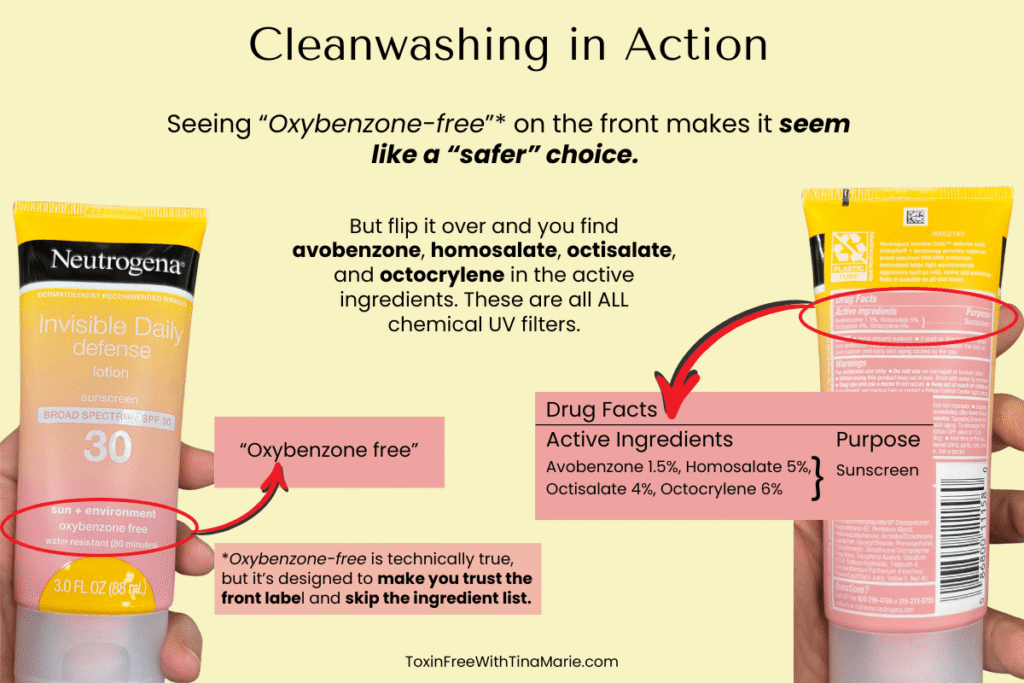
This is one of the biggest cleanwashing issues I see with sunscreen.
Some products proudly say “oxybenzone-free” right on the front label. And if you’ve done even a little ingredient research, that sounds reassuring.
But then you turn the bottle over and find avobenzone, octocrylene, homosalate, and octisalate.
In other words, the product is technically oxybenzone-free while still containing several other chemical UV filters.
This is technically true. But the claim is designed to make you think you’ve already found the safer option, so you stop reading the ingredient label.
And once you notice this type of cleanwashing , you start seeing it everywhere.
What the Research Actually Shows
A 2020 FDA clinical trial found that six common chemical sunscreen ingredients were absorbed into the bloodstream after just one application. Every one of them exceeded the FDA’s own threshold for requiring additional safety studies.
Oxybenzone raised the biggest red flags. It showed the highest blood concentrations in that study and has been detected in fetal and umbilical cord blood.
In addition, a 2023 review of 254 studies found mounting evidence of endocrine disruption at the doses people actually use. The EU reviewed that evidence and restricted oxybenzone use.
Researchers are still studying the long-term effects across chemical filters, effects on pregnancy, and cumulative daily exposure over years.
Zinc oxide and titanium dioxide are the only two ingredients the FDA currently proposes as GRASE (Generally Recognized as Safe and Effective). I don’t think that’s a coincidence, and it’s where I always start.
What To Look For in a Mineral Sunscreen
When it comes to mineral vs. chemical sunscreen, this is the point where my own decision became pretty clear. I choose mineral formulas that use non-nano zinc oxide as the active ingredient.
Non-nano zinc oxide is my starting point because the particle size matters. Nano particles are smaller, and research on long-term effects is still catching up.
When research raises valid concerns and there’s a well-performing alternative, that’s an easy decision for me.
The more you know about what’s in your sunscreen, the harder it is to settle for anything less than clean. And the good news is you don’t have to. Safer options exist, they work, and your skin doesn’t have to be the thing you compromise on.
How to Choose a Mineral Sunscreen
If you’ve decided to make the switch to mineral sunscreen, here’s what I’d look for when comparing products:
- Non-nano Zinc oxide as the active ingredient
- No chemical UV filters
- No undisclosed fragrance
- An inactive ingredient list that’s free of other red flag ingredients
Don’t stop after checking the active ingredient.
A mineral sunscreen can still contain undisclosed fragrance and other red flag ingredients in the inactive ingredient list.
The active ingredient tells you what protects your skin from the sun. The inactive ingredients tell you what else you’re putting on your skin. Both matter.
I reviewed some non-toxic mineral sunscreens, and spill the tea about what I liked, what I didn’t, and what I’d actually buy again. Check it out here: The Best Non-Toxic Mineral Sunscreens I Actually Use and Trust.
I also shared a list of safe non-toxic mineral sunscreen on Amazon in this post. You can shop my Non-Toxic Sunscreen Amazon Storefront here.
Not sure what to look?
I created a free Red Flag Ingredients Cheat Sheet to help you quickly identify some of the ingredient names I pay attention to when reading labels. It’s a simple place to start if you’re still learning how to evaluate ingredient lists. Grab it below.

Red Flag Ingredient Cheat Sheet
My free Red Flag Ingredients Cheat Sheet helps you start reading labels with more confidence, without the overwhelm.
Want to Go Deeper? (The Research Behind This Post)
These are a few of the resources I’ve spent time with while falling down my own science rabbit holes (so you don’t have to).
- Effect of Sunscreen Application on Plasma Concentration of Sunscreen Active Ingredients – JAMA (2020)
- Benzophenone-3: Comprehensive Review of the Toxicological and Human Evidence – Environment International (2023)
- Dermatological and Environmental Toxicological Impact of Oxybenzone/Benzophenone-3 –Journal of Cosmetic Dermatology (2018).
- FDA Proposed Order: Sunscreen Drug Products for Over-the-Counter Human Use — FDA Fact Sheet PDF (2020)
- A Review to Support the Derivation of a Worst-Case Dermal Penetration Value for Nanoparticles – Regulatory Toxicology Pharmacology (2021)
- The Safety of Nanosized Particles in Titanium Dioxide and Zinc Oxide Based Sunscreens – Journal of the American Academy of Dermatology (JAAD)(2009)
- Potential Photocarcinogenic Effects of Nanoparticle Sunscreens – Australasian Journal of Dermatology (2011)





This is interesting, I was wondering why there’re so many opinion about how bad sunscreens are for health, now I understand! Which mineral sunscreen do you suggest?
It can be so confusing with all the different options and ingredients, not to mention the cleanwashing. I wrote a review about sunscreens, including my favorites here: The Best Non-Toxic Mineral Sunscreens I Actually Use and Trust.
Oh my goodness, thank you so much for sharing this post! This is incredibly helpful (and in a way that’s easy to understand to). I’ve become so much more conscious about what I put on to my skin, SPF being one of them, so this is such a timely post.
I love that you’re paying attention to what you’re putting on your skin. And I’m so glad this post was helpful. Thanks for taking the time to comment. 🙂
This is very informative and explained in such a simple way. A lot of people use sunscreen every day and probably do not realize there are major differences between mineral and chemical sunscreens. I like how this breaks down the ingredients and how each type works because it really helps people make more informed choices for their skin and overall health.
You are so right… it can be very confusing at first. I’m glad this was helpful, and I really appreciate your feedback!
Wow! I learned so much reading this! Thank you for sharing
I’m so glad to hear that!
My dermatologist just explained the difference to me. Good info. Thank you for sharing. Saving for future reference.
So glad it was helpful!
Thank you for sharing the differences between mineral and chemical sunscreen, as well as safer options to choose from. Glad to see Crunchi as one of the products you recommend. It’s my top favorite mineral SFP
I’m so glad it was helpful! Crunchi and Counter are my two favorite clean brands.
I use mineral sunscreen. 🥰. Thanks for the information. i’m glad I read ingredients for everything.
That’s great! It’s so important to read ingredients. 🥰
I found this very interesting, I am definitely going to use chemical free mineral based sunscreens from now on.
I’m so glad you found it helpful. Mineral sunscreen is a great choice.